
How Force Sensors Improve Efficiency and Safety in Steel Mill Rolling Line
Rolling mills are central to steel production. Whether a facility is producing structural beams, flat-rolled sheet, or wire rod, the forces involved vary considerably by mill type and product - and in heavy plate or slab applications, those load ranges can be extremely large.
Keeping those forces accurately measured and controlled is not a refinement. It is a basic requirement for consistent product quality, equipment reliability, and operator safety. Force sensors make that measurement possible. They convert mechanical load into reliable process data that control systems can act on in real time, giving operators and engineers a clear picture of whether the line is running as it should.
In this post, we will walk through how force sensors are used throughout the rolling process, why accurate roll force measurement matters for both quality and safety, and how modern sensor technology supports the automation strategies that steel producers are increasingly relying on.
The Role of Force Sensors in Steel Rolling Mills
A rolling mill works by passing heated or cold steel between two or more rotating rolls, reducing its thickness or changing its cross-section with each pass. The mechanical forces generated at the roll gap are substantial, and any deviation from the intended force profile affects the geometry, surface condition, and mechanical properties of the finished product.
Rolling mill force sensors are installed within or on key load-bearing points of the mill structure to capture these forces in real time. Common installation points include:
Roller bearing housings, where sensors sit between the housing and the mill frame to measure the reaction forces generated at each roll
Mill stand columns and roll chocks, where load cells measure the separating force between the work rolls
Strip tension systems between mill stands, where sensors track the tension applied to the strip as it moves through the line
These sensors operate in both hot rolling and cold rolling environments, though the demands placed on them differ considerably. Hot rolling mills expose sensors to elevated temperatures and scale debris, while cold rolling lines involve higher precision requirements and more aggressive coolant chemistries.
How Force Sensors Improve Process Efficiency
The value of accurate force data becomes clear when you consider what happens without it. Rolling without reliable measurement means relying on model predictions and operator judgment alone. Over time, roll wear, temperature variation, and material inconsistencies will cause the actual rolling conditions to drift from what the control system assumes.
Installing calibrated load cells in steel mills gives the control system something concrete to work with: real-time force feedback that reflects what is actually happening at the roll gap, not what was expected.
Precise Thickness and Shape Control
The gap between the work rolls is the primary variable that determines strip thickness. Force feedback tells the Automatic Gauge Control (AGC) system whether the roll gap is behaving as intended, allowing it to make continuous corrections. When a change in material hardness or temperature causes the separating force to shift, the system can compensate before the effect shows up in the finished product. Without this feedback, dimensional tolerances widen, and achieving tight specifications becomes difficult.
Reduced Material Waste
Off-specification material either gets downgraded or scrapped, both of which carry real cost. Consistent force control reduces the frequency of these outcomes by keeping the rolling parameters within a tighter range across the full length of a coil or slab. For high-value grades where material costs are significant, this improvement in yield adds up quickly.
Energy Optimization
Rolling mills consume large amounts of electrical energy, particularly in the main drive motors. When force sensors are integrated with the drive control system, the system can apply exactly the force the material requires at each pass, rather than running drives at a fixed conservative setting. This avoids unnecessary loading on motors and drive systems, reduces energy consumption, and extends the service life of drive components.
Improving Safety in Rolling Mill Operations
Rolling lines are among the most mechanically demanding environments in manufacturing. The combination of massive equipment, high-speed moving steel, and extreme forces creates conditions where abnormal events can escalate quickly. Force measurement plays a direct role in catching problems before they become dangerous.
Early Detection of Abnormal Conditions
Force sensors continuously monitor the load profile at each stand. Sudden force spikes can indicate abnormal strip behavior, overload conditions, misalignment, or developing mechanical problems in the pass. Gradual force increases can point to roll wear, bearing degradation, or lubrication loss. Roll misalignment often produces asymmetric force readings across the width of the strip. In each case, the sensor data provides the earliest available indication that something is wrong.
Automatic Shutdown and Safety Controls
Most modern rolling lines integrate their force sensors into the plant control system, allowing the system to trigger alarms or initiate an automatic shutdown when readings exceed predefined limits. This removes the dependency on an operator catching an abnormal condition visually or audibly, which is unreliable in a loud, fast-moving rolling environment. The sensor becomes part of the safety architecture of the line, not just a process measurement.
Reduced Operator Exposure
When force data is feeding an automated control loop, operators spend less time making manual interventions near active mill stands. Rolling mill automation enabled by reliable sensor data keeps the operation running within normal parameters for longer stretches, and the interventions that do occur are better informed by real data rather than observation alone.
Types of Force Sensors Used in Rolling Lines
The choice of sensor depends on what is being measured, where it is installed, and what environmental conditions it must withstand. The three primary sensor types used in rolling mill applications are:
Roll Force Load Cells
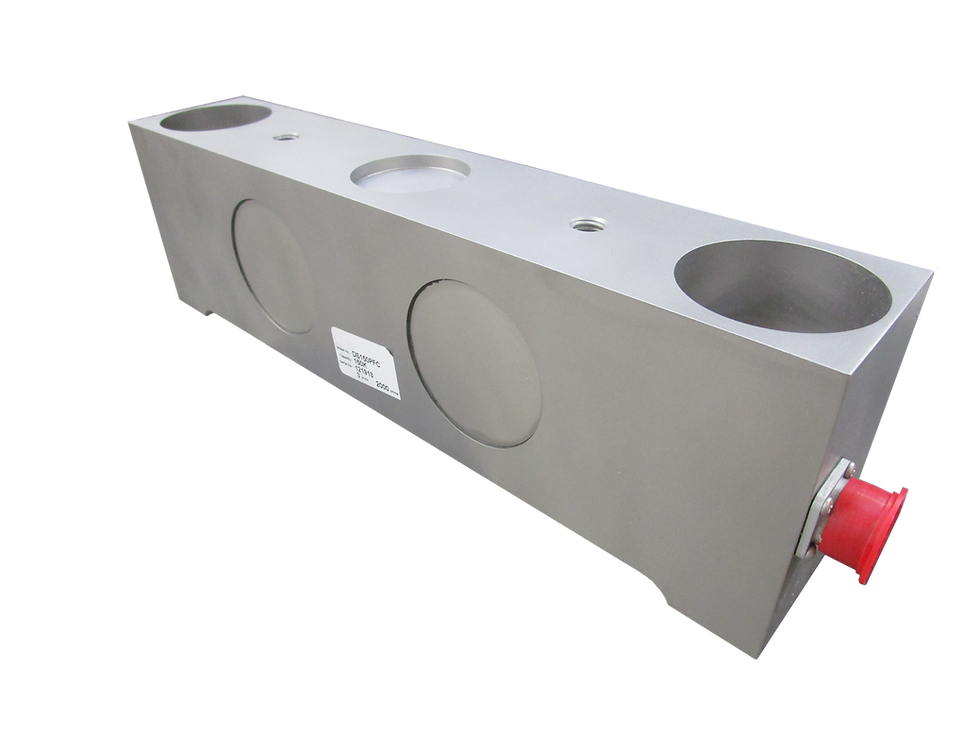
These are purpose-built load cells in steel mills that sit within the mill stand to measure the separating force between the work rolls directly. They are designed for high-capacity applications and must withstand the mechanical shock and vibration that are inherent to the rolling process. Capacity requirements vary significantly, from lighter cold mill stands to heavy plate or slab mills where forces can reach into the millions of pounds.
Strain Gauge Sensors
Rather than measuring force directly, strain gauge sensors measure the deformation of a structural element in the mill - typically a column, frame member, or load-bearing plate. Because they can often be applied to existing mill structures with fewer installation constraints than a discrete load cell, they are commonly considered for retrofit applications where space or layout is limited.
Strip Tension Sensors
In a tandem rolling mill, the tension maintained in the strip between stands affects both thickness control and strip shape. Tension sensors, typically mounted on bridle rolls or looper systems, provide the force measurement that allows the control system to regulate interstand tension continuously. Accurate tension data is particularly important in thin-gauge rolling, where small deviations can result in strip breaks or flatness defects.
Integrating Force Sensors into Smart Steel Manufacturing
Steel producers have been adopting Industry 4.0 principles at an accelerating pace, and force measurement infrastructure is central to that shift. Sensors that once fed only the basic control system are now connected to broader data networks where their output contributes to a much wider range of analytical functions.
In a modern integrated mill, rolling mill force sensors feed data into programmable logic controllers (PLCs) and SCADA systems in real time. Force data can support advanced analytics, predictive maintenance, and digital-twin initiatives in more connected mills, allowing process engineers to model the behavior of the mill under different material grades, temperatures, and rolling schedules. The result is a rolling operation that becomes progressively better understood and better controlled, because every coil or slab that passes through the mill adds to the data set.
Key Benefits of Force Sensors in Rolling Lines
When force measurement is applied correctly in a steel rolling line, the benefits can be seen across production, maintenance, and safety. Summarizing the practical outcomes, well-integrated force measurement delivers:
Improved dimensional accuracy and consistency in finished steel products
Higher throughput efficiency by reducing off-grade material and unplanned stops
Lower scrap and rework rates across the production schedule
Reduced mechanical wear on rolls, drives, and mill structure through better load control
Enhanced operator safety through automated detection and response to abnormal force conditions
Last, you’ll also benefit from better process visibility, with data that supports continuous improvement and rolling mill automation initiatives.
Why Force Sensors Are Essential for Modern Steel Mill Rolling Lines
The pressures on steel producers today - tighter tolerances, leaner inventories, energy costs, and safety compliance - all point toward the same requirement: more precise, more reliable control over the rolling process. Force sensors are the measurement foundation that makes that control possible.
Real-time force data gives control systems something accurate to act on at the roll gap. It protects equipment from overload events that would otherwise cause costly unplanned shutdowns, and it reduces the need for manual intervention in areas where the risks to personnel are significant. For process engineers, the data accumulated across every coil and every pass is what makes it possible to optimize rolling schedules, anticipate maintenance needs, and build a case for continuous improvement that is grounded in evidence rather than observation.
What to Consider When Selecting Rolling Mill Force Sensors
Choosing the right sensor for your application comes down to a few key factors:
Capacity range: Does the sensor cover the full load range your mill stand will see under normal and peak conditions?
Temperature environment: Hot rolling and cold rolling present very different thermal demands, and the sensor must be rated accordingly
Installation geometry: The physical space available in the mill stand will determine what sensor form factor is practical
Control system interface: The sensor output must be compatible with your existing PLC or SCADA infrastructure
Working with a leading manufacturer that has direct experience in steel mill force measurement, backed by calibration capabilities traceable to national standards, is the most reliable way to ensure your sensors perform as required under real operating conditions. Their team of experts can help you match the right force measurement solution to your application, whether you are specifying sensors for a new rolling line or replacing an existing system.
Ready to Improve Force Measurement on Your Rolling Line?
Learn how advanced force measurement solutions can improve safety, efficiency, and quality in your rolling operations. MSNST has been engineering and manufacturing load cells for industrial applications, including steel mill environments, for over 40 years. Our in-house team can help identify the right solution for your rolling line, backed by calibration capabilities that are NIST-traceable up to 1,000,000 lbs with secondary traceability to 1,600,000 lbs. Contact our team to discuss the right force sensors for your steel mill application.


Comments